Heir to the Harrakan throne
The Calamitous BobHeir to the Harrakan throne is the status assigned to Viviane Saint-Lys when Solfis infers that her birth within the Imperial Palace makes her the surviving member of the Harrakan imperial family. It is not a title she seeks or understands at first, but an identity reconstructed from ruins, magical evidence, and the absence of every other imperial relative. The designation gives her a political history before she has a place in the present, making her simultaneously a displaced survivor, a potential sovereign, and the last living remainder of a civilization destroyed by its own catastrophe.
Origin in the Imperial Palace
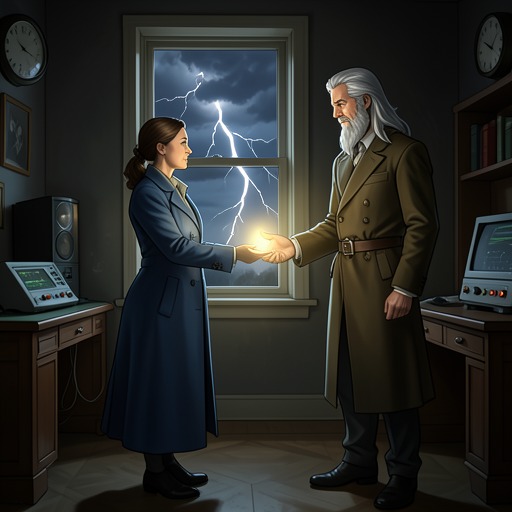
The title emerges during Solfis’s attempt to verify Viviane Saint-Lys’s account of herself. The golem core treats her stated place of origin as consistent with the current distribution of mana, then proposes that she bind with the core so the information can be confirmed. The request is presented as a significant personal sacrifice, making the recognition of her identity inseparable from a dangerous act of trust and bodily or spiritual commitment. Viviane Saint-Lys does not initially understand why such a sacrifice is necessary, but the verification produces a chain of conclusions that changes her position completely.
Solfis’s reasoning rests on the Imperial Palace’s exclusive birth rule: only members of the imperial family could give birth within the palace. Viviane Saint-Lys was born there. From those two premises, the golem identifies her as a member of the Harrakan imperial family and then establishes that all other members have perished. The status is therefore not based on a living court, a public ceremony, or a recognized succession process. It is an archival and inferential title, extracted from the surviving rules of a dead regime and applied to the one person who remains.
A Crown Reconstructed from Ruins
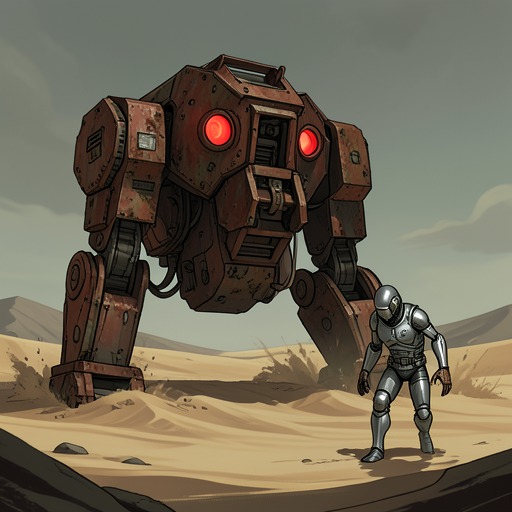
The force of the designation is heightened by the condition of the world in which it is made. Param contains the Western scar of the greatest magical catastrophe ever recorded: a vast valley ringed by snow-capped mountains, dark at its core and gradually reclaimed by enduring vegetation. The Old Empire once ruled from that region, terrifying the world through unprecedented magical achievement before weaving its own destruction. Its legacy survives only in private collections and in the languages of kings, while mindless undead now cross its sandy corpse.
The Imperial Palace is not merely an abandoned residence. Viviane Saint-Lys encounters a planned dead city extending for kilometers from the summit of an enormous pyramid, with estates, temples, churches, and squares emptied of movement. Basaltic sand runs toward distant mountains, and rubble as large as apartment buildings lies across the landscape. At the pyramid’s summit, the former apex has been replaced by a gigantic crater whose molten, vitrified edges suggest an asteroid impact or a tactical nuclear strike; crucially, the destruction came from inside. The heir’s inheritance is thus defined by an empire that reached its height and then annihilated its own center.
This setting makes the title a paradox. It names the legal survivor of a power that has vanished materially, politically, and morally. Viviane Saint-Lys inherits neither a functioning court nor secure territory. She inherits the evidence of catastrophe, the language of imperial command, and the unresolved question of what should be done with an authority whose former seat has become a graveyard.
Princess Bob and Solfis’s Allegiance
Solfis immediately treats the inferred succession as a command relationship. It asks Viviane Saint-Lys to state her name and addresses her as the heir, using the ceremonial formula that she should live long. Viviane Saint-Lys attempts to make the arrangement manageable by asking to be called Bob instead. Solfis accepts the request but converts the casual name into a formal designation, granting her the title Princess Bob and pledging itself to her.
That exchange turns an abstract status into an operational alliance. Viviane Saint-Lys needs assistance to escape the dead city, and she assumes that the elevated status is connected to Solfis’s ability to survive and help her. Solfis, by contrast, treats the title as a genuine imperial command structure. Its allegiance gives her a powerful protector, but it also imports the old empire’s hierarchy into every later encounter. The title is therefore useful precisely because Solfis believes in it, even when Viviane Saint-Lys does not.
The resulting relationship contains a persistent comic and political friction. Viviane Saint-Lys repeatedly asks Solfis to stop threatening people and demanding that she be called princess. Solfis initially regards the Baranese knights as lowly and is willing to provoke them, while Viviane Saint-Lys understands that imperial claims can become dangerous when made in front of representatives of another nation. Her effort to control Solfis is also an effort to control the consequences of an identity she never deliberately adopted.
The Title in a Post-Imperial World
The status carries little obvious diplomatic power outside Solfis’s loyalty. When Viviane Saint-Lys speaks with knights from Baran, she learns that the Harrakan heartlands are marked on their map with a skull and that several countries lie between the old imperial territory and Baran. Baran occupies the far eastern part of Param and is the continent’s largest kingdom, while the ruined Harrakan center belongs to a feared and inaccessible past. The map turns the heir’s supposed domain into a geopolitical absence.
Her movement toward Kazar further exposes the distance between imperial inheritance and contemporary politics. Kazar belongs to Enoria, a kingdom that split fifteen years earlier after its king’s purge of the nobility led to rebellion and a two-year civil war. The city now stands near the border between the two sides, with a strong church and mercenary presence but no major strategic value. Viviane Saint-Lys therefore enters a fragmented political landscape in which local rulers, churches, mercenaries, and investigators hold practical authority, while her imperial title remains a suspicious relic.
The title also intersects with the Deadlands and the economy built around them. Cernit reports that a necromancer has destroyed the two nearest forts, and Kazar serves as a base for expeditions into the Deadlands because the Church of Neriad pays one iron bit for every Revenant head. The church can verify kills, exorcise the remains, or use a magical tool to measure the work. Against this background, Viviane Saint-Lys’s inherited status does not restore imperial order; it places her inside a frontier system where survival, church recognition, mercenary labor, and demonstrated power matter more than dynastic legitimacy.
Authority, Threat, and Change
As Viviane Saint-Lys learns more about the world, the heir identity becomes less a revelation and more a tool whose risks she must manage. Solfis’s translation helps her communicate with the Baranese knights, while its interruptions and imperial assumptions complicate those conversations. Later, when she studies a book of runes with Solfis’s translation assistance, the process accelerates her learning and allows her to focus better. The heir is consequently not only a political label: it is the organizing identity around which a machine servant, lost imperial knowledge, and practical education begin to converge.
The designation also amplifies the danger of her own developing power. In the house of Neriad, a man warns that striking her would make no land on Param safe for her opponent. Viviane Saint-Lys answers that she need not raise a hand to make his life miserable, then recognizes that her intimidation has gone too far and decides that she must own the effect. Her reasoning is explicitly tied to being a black witch and possessing formidable power. The heir’s authority and her magical reputation reinforce one another, producing a public persona that can command fear even when no throne, army, or state stands behind it.
Her status is further tested through her relationships with non-human peoples and frontier politics. A church official explains that Marruk is a female Kark who left what remained of her tribe, while the Kark are suffering hardships partly connected to conflict with the Pure League. He insists that Marruk does not deserve the abuse imposed by local mercenaries and describes the Kark as unusually committed to fulfilling their promises. Viviane Saint-Lys’s interest in whether humanity is at war with the Kark places her inherited imperial identity beside the contemporary question of how power treats outsiders. The title can imply conquest, but her conduct increasingly requires negotiation, restraint, and the deliberate granting of trust.
Heir to the Harrakan throne therefore remains an unresolved state rather than a completed political achievement. Viviane Saint-Lys is the last surviving member of the family by the rules Solfis can establish, but the empire is a dead center marked by an internal explosion, its heartlands are treated as a skull on a foreign map, and the surrounding world has developed its own kingdoms, churches, alliances, and frontier economies. The title gives her Solfis’s allegiance and a language of authority, yet it also forces her to decide what that authority can mean after imperial collapse. Its decisive narrative function lies in that tension: Viviane Saint-Lys does not simply recover a lost crown; she must carry the burden of inheriting a civilization whose greatest monument is the evidence of its self-destruction.